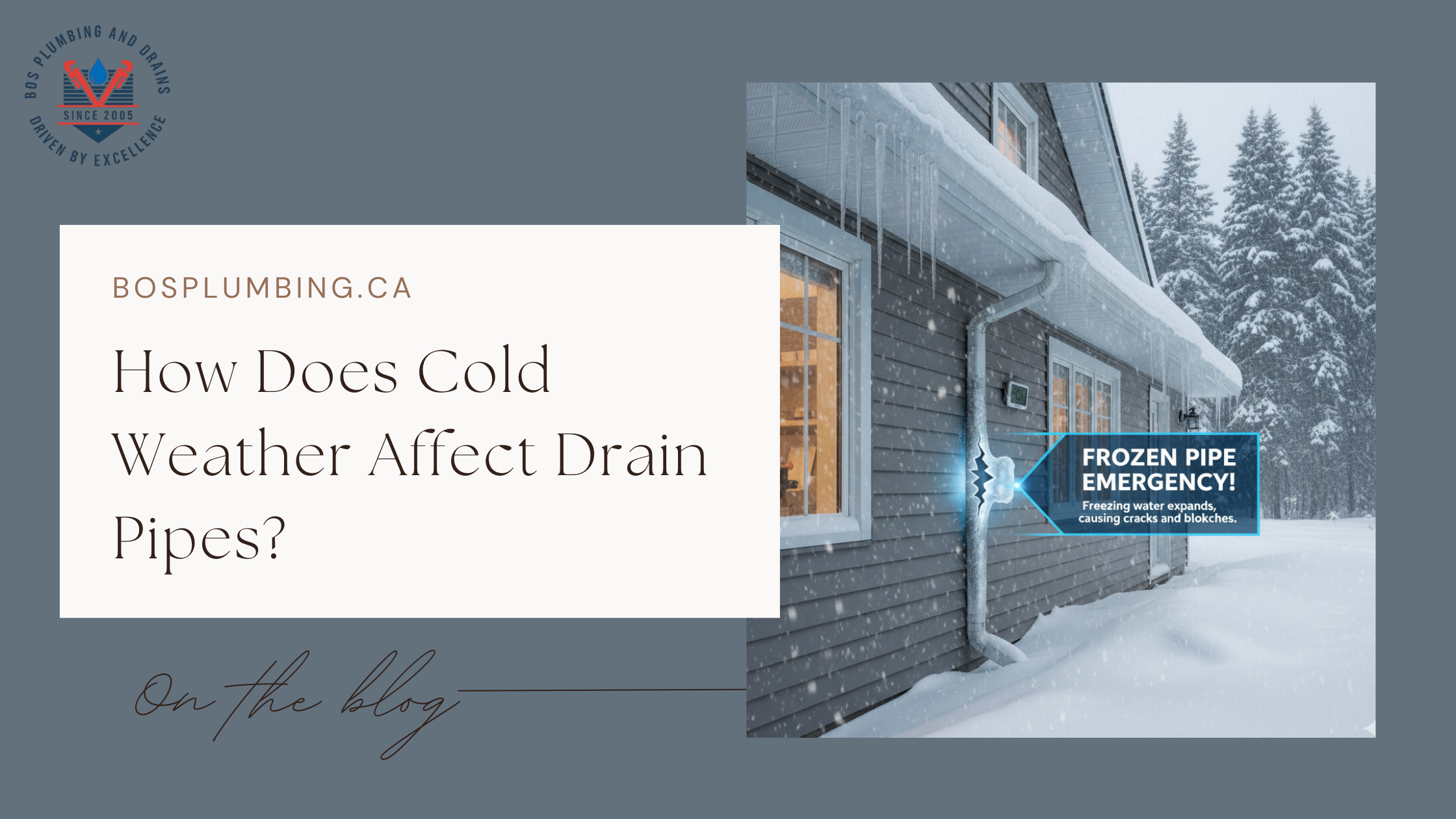
As Canadians, we take pride in surviving the “Great White North” winters. We have the best parkas, we know how to drive in a blizzard, and we never underestimate a -30°C forecast. However, while we’re cozying up with a Tim’s coffee, our drain pipes are fighting a silent, freezing battle underground and behind our walls.
When the weather goes below zero, water in pipes may freeze up and burst resulting in significant damage to the plumbing.
It is among the most prevalent winter plumbing problems experienced by the homeowners in different parts of Canada each year. From frozen drain pipes to clogged sewer lines, cold weather can impact nearly every part of your household plumbing.
Cold weather does not simply leave you shivering, but it gives your whole plumbing system an immense physical strain.
The decreased temperature at the sink trap in your kitchen, to the main underground drainage pipe can cause costly catastrophes in the event you are unprepared.
Here we shall look at the impact of the Canadian cold on your plumbing and what you can possibly do to prevent an emergency mid-winter.
Why Cold Weather Is Hard on Drain Pipes
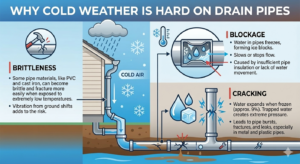
As the temperature drops, the water that is inside your pipes does not act the same way.
Physics gives us the answer that when water freezes it expands.
That expansion is thousands of pounds per square inch of pressure in such a small area as a copper or PVC pipe.
The Science of Frozen Pipes
The major worry of any Canadian homeowner would be frozen pipes.
The ice that forms in the inside of a pipe causes a blockage.
However, it is not only the clog that poses a danger, but the pressure accumulation of what is between the ice blockage and the closed faucet.
This is what ultimately culminates into bursting pipes.
Ground Shift and External Drainage
It is not only the pipes in your house.
The “frost line” in Canada may go a couple of feet deep.
With the freezing and thawing of the ground, the soil moves.
This motion may exert a strain on your underground drainage pipe which may crack or form a belly in the line resulting in a clogged sewer line.
Many Canadian homes experience problems such as:
- Frozen pipes in kitchens and bathrooms
- Plumbing clogged drain issues
- Slow drainage due to ice buildup
- Underground drainage pipe damage
If not addressed early, these problems can turn into expensive plumbing repairs.
The Vulnerability of the Sink Trap and P-Trap
There is a trap in every fitting in your house.
It can be a p trap sink or s trap sink, but they are merely made to trap a little water to prevent the entry of sewer gases into your house.
Since these traps have standing water, they are highly prone to pipe freezing when they are close to an external wall or an unheated cabinet.
Kitchen Sink Plumbing Risks
The sink drain tap in kitchen sink plumbing may be in a cabinet in front of an external wall.
When it is very cold in Canada, the temperature in that cabinet can be below freezing.
When that sink trap is frozen, the growing ice may break the plastic or metal resulting in a sloppy leak when the ice melts.
Pro Tip: During extreme cold, leave your cabinet doors open to allow warm air from the house to circulate around the pipes.
Beyond Freezing: Clogs and Sewer Line Issues
Winter also affects the way we use our plumbing.
There is a tendency to cook at home and hence more fats and oils to flow down the drain.
During cold weather, the fats become solid at a very rapid rate forming clogged pipes which are stubborn to clear away.
Tree Roots and Sewer Lines
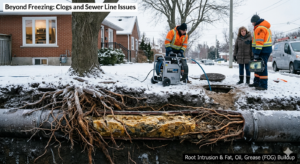
Trees may not seem to be active during the winter season, however, tree roots in sewer line systems are a thorn in the flesh.
Roots are in search of water and the hot water that is flowing in your sewer pipes is a target that cannot be resisted.
When roots locate a small crack, they multiply within, trapping debris and leading to a clogged sewer line.
The Need for Sewer Line Cleaning
You may require professional sewer line cleaning, in case your drains are gurgling or slow.
Techniques such as hydro jetting involve the use of high pressure water to cut through ice, grease as well as roots.
In most cases when the damage is too serious, you might be faced with estimates of sewer line replacement cost which is very high during the winter season since excavation is done with frozen soil.
Frozen Drain Pipes: What Actually Happens?
Frozen drain pipe: This happens when standing water within the pipes freezes and prevents the wastewater to run.
As opposed to supply pipes, drain pipes transport wastewater, grease, soap residual and food debris.
These substances are capable of freezing in case of a drop in temperature.
This issue often starts in areas with poor insulation such as:
- Basements
- Garages
- Exterior walls
- Crawl spaces
Once freezing begins, water pressure builds behind the ice blockage. Eventually, the pipe may crack, leading to a burst water pipe or severe water damage inside the home.
Warning Signs Your Drain Pipes Are Freezing
Early detection can prevent major plumbing damage. Watch for these signs:
- Slow draining sinks or bathtubs
- Strange gurgling sounds in pipes
- Water backing up in sinks or toilets
- Sewer odors coming from drains
- Frost on exposed pipes
If you notice these issues, your drain pipes may already be freezing.
Preventing a Burst Water Pipe This Winter
A burst of water pipe is a nightmare which can lead to thousands of dollars worth of water damage within minutes.
Prevention is always cheaper than a plumbing repair.
- Insulate Exposed Pipes: Foam sleeves should be applied on any drain pipes that are not heated such as in basements, crawlspaces or attics.
- Seal Air Leaks: Find the holes where pipes enter outside walls and stuff them with caulk or spray foam to prevent the wind chill from having access to the metal.
- Maintain Your French Drain Pipe: Have your french drain line and other drainage systems which run out of the house emptied of debris before the first snow. In case they back up and freeze, then they can push water back to your foundation.
- Drip Your Faucets: This sounds easy, yet the constant drip will keep the water flowing and will remove the pressure that causes broken pipes.
What Should You Do If Your Drain Pipes Freeze?
If your drain pipes freeze, quick action is important.
Try these steps:
- Stop using water immediately
- Apply gentle heat with a hair dryer or heating pad
- Avoid open flames or high heat sources
- Monitor pipes for cracks or leaks
If the pipe remains blocked or you suspect damage, contact a 24 hour plumber immediately. Emergency plumbers can thaw pipes safely and prevent further damage to your plumbing system.
How much does sewer line repair cost in Canada?
If freezing damages underground pipes, homeowners may need sewer line repair near me services.
The sewer line replacement cost in Canada depends on:
- Pipe length
- Soil conditions
- Type of pipe material
- Excavation requirements
Early repairs are usually much cheaper than full sewer line replacement.
When to Call a Professional: Why BOS Plumbing & Drains is the Answer

In some cases, a hairdryer and some insulation cannot help fight the Canadian deep freeze.
When the sewer line is completely clogged, you are suspecting a clogged sewer line, or you hear the horrific noise of rushing water behind the wall, then it is time to invite the professionals.
BOS Plumbing & Drains is the plumbing company that deals in the type of high-stakes residential plumbing repairs which the winter in the Greater Toronto Area requires.
The issues with drain pipes increase in complexity when the temperature decreases and having a local team that is knowledgeable on specific infrastructure and climate of the GTA is priceless.
Why Choose BOS Plumbing & Drains?
- 24/7 Emergency Response: Plumbing disasters do not have a 9 to 5 schedule. It could be a burst water pipe at 3 AM, it could be a p trap sink that has been frozen solid on Christmas morning, they are available round the clock.
- Advanced Diagnostics: They inspect the walls with camera advanced technology before they dig or cut holes in the walls to determine the exact location of frozen pipes or obstructions.
- Specialized Winter Services: Ranging between the safe thawing of broken pipes and expert sewer line cleaning, their staff is prepared with specialized industrial grade equipment to perform tasks in the cold.
- Upfront Pricing: No one wants a surprise in his bill. They also prioritize open dialogue hence you are aware of sewer line replacement cost or repairing the sewer line.
The Power of Hydro Jetting
BOS Plumbing & Drains can provide hydro jetting where the heavy-duty blocks are too heavy to be reached using the normal snaking method.
This is not done by merely punching a hole into the ice or grease; it is done by scrubbing down the inside of the pipes using high pressure water.
This works especially well with household plumbing within Canada where mineral deposits and hardened fats can constrict pipes with time and hence even more easily freeze them.
Winter Plumbing FAQs
1. How do I know if my drain pipes are frozen?
Usually, the first sign is a faucet that only produces a trickle or a drain that won’t flow at all. You might also notice frost on the visible portions of the pipes or a strange smell coming from the drain.
2. What is the average sewer line repair near me cost in Canada?
In cities like Toronto, sewer line repair near me can range from $1,500 to $5,000 depending on the depth of the pipe and the severity of the break. Trenchless repairs are often preferred in winter to avoid excavating frozen lawns.
3. Can I use a hair dryer to thaw a frozen drain pipe?
Yes, a hair dryer or a space heater (kept at a safe distance) is a safe way to thaw a frozen drain pipe. Never use an open flame or torch, as this is a fire hazard and can cause the pipe to burst from rapid temperature change.
4. Why does my residential plumbing smell worse in the winter?
When it’s cold, we keep windows shut, reducing ventilation. If your p trap sink dries out or freezes and cracks, sewer gases can seep into the home. Additionally, ice buildup on your roof’s plumbing vent stack can trap gases inside.
Conclusion
Learning to respond to cold weather affects your drain pipes is a part of being a strong-willed Canadian homeowner.
Out of the dainty sink-trap, to the rocky underground drainage pipe, all of your system is vulnerable when the mercury falls below zero.
Warming your home, making sure that no air gets in and out of your house, and understanding when to call BOS Plumbing and Drains to have the sewer line cleaning is the best way to keep your water flowing until the spring thaw comes.