

When renovating your home or having a plumbing problem, one question on everyone’s mind is – to choose copper plumbing or PEX plumbing? It is one of the most controversial subjects among homeowners and contractors in Canada and there’s a good reason for that! While both materials have their advantages and disadvantages, the decision on which to choose comes down to your home, budget and future plans.
Let’s do this the way a real plumber would do it, without the jargon, without the mumbo-jumbo, and to the point.
What Is PEX Plumbing and Why Is Everyone Talking About It?

PEX plumbing (cross linked polyethylene) has revolutionized the world of residential plumbing in the last 20 years. You’ve probably seen those flexible, colourful tubes red for hot and blue for cold, snake their way through walls and floors if you have had any plumbing work done or watched one of the home improvement shows.
PEX pipe is easy to install, flexible and lightweight. Plumbers enjoy it since it curves around corners without having to have a further fitting, indicating that there is less likelihood of leak points in the plumbing system. It is a lot cheaper than copper and is a popular choice among homeowners.
Here’s what makes PEX plumbing pipe stand out:
- It’s freeze-resistant a huge deal in Canadian winters
- It doesn’t corrode or develop mineral buildup the way metal pipes can
- It’s quieter, reducing the “water hammer” noise that plagues some older homes
- PEX pipe in pipe systems allow even easier installation and replacement
- PEX plumbing fittings are widely available and compatible with multiple connection methods
In the GTA and beyond, PEX is the preferred plumbing material for most professionals in the house plumbing, kitchen plumbing and bathroom plumbing industry.
The Case for Copper: Why It’s Still in the Game

Copper plumbing has been the benchmark for residential plumbing for more than 70 years, and it’s no coincidence that it’s still a thing of value. Copper is a long lasting material, biostatic (bacteria don’t like to live on it), and has a proven record of generations.
Copper piping has proven to be reliable in high-temperature applications, and can be used on hot water lines near water heaters and boilers. It is also 100% recyclable and an environmentally friendly material.
Here’s where copper still shines:
- Extremely long lifespan copper pipes can last 50 years or more
- Handles high water pressure with ease
- Safe for drinking water with no risk of chemical leaching
- Works well for outside plumbing and exposed pipe runs
- Adds value to a home during resale inspections
However, copper pipe has its share of drawbacks, as well. It’s costly in terms of the materials and the labor that it requires. It is stiff, and thus needs more joints and connectors. Copper is especially prone to developing pinhole leaks in the years to come in areas of acidic water (which is prevalent in parts of Ontario).
You’ve seen copper pipe leak repair jobs done, no doubt you know that it’s no quick Saturday morning job. Typically this involves hiring a professional.
Is PEX or Copper Better for Canadian Homes?
This is the question most Canadian homeowners are really asking. And the honest answer is: it depends on your situation but PEX is winning ground fast.
In regions where the weather is colder, such as Southern Ontario, Niagara Region, the Hamilton and Cambridge areas, PEX pipe has a significant practical advantage. PEX can expand and contract and won’t crack when it freezes in the pipe. Copper, on the other hand, can burst and when a pipe bursts in the cold winter months it’s a plumbing situation that no homeowner wants to encounter.
In new construction projects, or extensive renovations, most modern plumbers now suggest using PEX as the primary plumbing material for use in household plumbing. Much quicker to install, more economical and works great for bathroom plumbing and kitchen plumbing.
For short runs around water heaters, outdoor hose bibbs, or when pipes can be exposed to the sun, however, copper is the better option as the sun will break PEX over time.
The smart approach? A hybrid system PEX for most of the home plumbing system, with some copper or CPVC strategically placed where heat or UV exposure is an issue.
PEX vs Copper Plumbing: What’s the Difference?
| Feature | PEX Plumbing | Copper Plumbing |
| Material Type | Flexible plastic piping | Metal piping |
| Installation Speed | Faster and easier | Slower and labour-intensive |
| Cost | More affordable | More expensive |
| Flexibility | Highly flexible | Rigid |
| Freeze Resistance | Better resistance to freezing | Can burst more easily in winter |
| Lifespan | 40–50 years | 50+ years |
| Corrosion Resistance | Does not corrode | Can corrode over time |
| Water Pressure | Consistent performance | Excellent performance |
| Noise Level | Quieter water flow | Louder water movement |
| Repair Costs | Lower plumbing repair costs | Higher repair costs |
| Best For | Modern residential plumbing, basement renovations, bathroom plumbing | Long-term durability, exposed piping |
| UV Resistance | Poor — needs protection from sunlight | Excellent UV resistance |
| Installation Method | Uses pex plumbing fittings | Requires soldering |
| Suitability for Canadian Winters | Excellent for cold climates | Good but vulnerable to freezing |
| Common Problems | UV damage, fitting issues | Corrosion, pinhole leaks |
| Emergency Repairs | Faster for emergency plumber visits | More time-consuming |
| Popular Choice Today | Preferred in modern home plumbing | Common in older household plumbing systems |
What About the Cost Difference?
Let’s discuss numbers since budget is important with most families in Canada.
PEX pipe costs generally in the range of 25–35% less than copper pipe per linear foot. The labour savings factor in the faster installation and the less fitting, brings the total cost savings to much greater. If you had to go ahead and re-pipe your entire residential plumbing system, you may have thousands of dollars to save by opting for PEX over copper.
Although copper plumbing is more costly upfront, it can be a bit more valued in upscale custom homes where homeowners might require the best. When it comes to the typical Canadian homeowner, however? The price tag for PEX is not to be taken lightly.
What Do Plumbing Experts Recommend? Copper vs. PEX
Today, most GTA plumbers will recommend a hybrid solution, depending on the building.
Experts Usually Recommend PEX For:
- New residential plumbing installations
- Basement renovations
- Bathroom plumbing upgrades
- Kitchen plumbing remodels
- Emergency plumbing repairs
- Large home plumbing projects
Copper Is Still Recommended For:
- High-heat applications
- Certain commercial plumbing systems
- Exposed piping areas
- Homes requiring maximum longevity
In most situations, the professional plumbing companies include both materials with the exact same plumbing system.
Which Pipe Material Works Best by Area and Property Type?
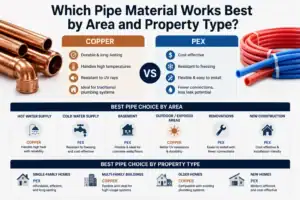
This isn’t something that many blog posts discuss but it’s one of the most useful questions that any homeowner or property manager in Southern Ontario can ask. Don’t forget that PEX vs copper isn’t only a matter of PEX or copper pipes. It also is dependent on the location and type of property you have.
Below is a breakdown by property-type, and by region, according to actual conditions throughout the GTA and beyond:
1. Toronto
Toronto is home to a blend of century old houses in the Annex to newly constructed condos in downtown. Many older Toronto houses still have original copper pipes – or even galvanized steel pipes – that are long outdated.
For Toronto residential homes: PEX is highly recommended for repipes because most of the homes are old and there is a savings on labour cost. Now, most local plumbers in Toronto contractors begin to use PEX for entire home plumbing replacement.
For commercial buildings and condos in Toronto: Copper or Copper/PEX hybrid is recommended for commercial buildings and Condos in Toronto. In high-rise buildings and other areas with special requirements for water pressure, fire code, and other factors, copper’s durability proves itself. In multi-unit buildings, licensed plumbers Toronto residents depend on are going to usually advise the installation of PEX risers and copper branch lines.
2. Mississauga and Oakville
Most of these are suburban, and consist of a mix of 80’s to 00’s tract homes and newer construction. Most of the water is of good quality and there is a reduced concern about copper corrosion in the water in Mississauga and Oakville.
For residential plumbing in Mississauga and Oakville: Copper and PEX; PEX is becoming the more popular choice as the preferred option for new construction and renovations. This is a huge cost saving and important for winter weather.
For commercial properties: Copper piping is still found in older buildings in Mississauga such as office buildings and plazas. If you own a commercial building constructed prior to 2000, it is probably lined with copper and a professional plumbing repair evaluation is an intelligent investment to make before issues occur.
3. Hamilton
Hamilton is no stranger to a variety of property ages, from historic homes in the lower city through to new subdivisions on the mountain. Historically, the mineral content or hardness of the water in the city has been higher in some areas, which, over time, can cause copper pipes to corrode.
For residential homes in Hamilton: PEX may be a better long-term option for older neighbourhoods where water chemistry may be harsh on copper. Most household plumbing in Hamilton is now being done with a complete replacement of the copper pipes with PEX.
For commercial and industrial properties in Hamilton: Many older commercial buildings have large diameter copper piping systems as Hamilton has an industrial heritage. It will be expensive to replace these as wholesale, and a hybrid solution (keeping copper mains but replacing branch lines with PEX) is a viable and cost-effective solution.
4. Milton and Cambridge
The area has experienced an explosive growth in the number of residential homes in both Milton and Cambridge in the last 10 years, and a significant percentage of homes there are relatively new home construction, many of which have had original PEX plumbing installed.
For residential plumbing in Milton and Cambridge: Most new houses already have PEX in the plumbing and it is successful. A plumbing inspection is recommended for older homes located in the heart of Cambridge; certain older homes may still contain original copper or galvanized plumbing.
For commercial properties: PEX or CPVC are newer materials used for interior distribution lines; copper is used in a mechanical room or for high pressure applications in newer commercial developments in Milton. This ensures that you don’t end up spending excessive amounts of money while building the house, but also maintain its functionality over time.
5. Niagara Region
Water in the Niagara Region has a particular issue – it is harder and more mineralized water, which is extremely difficult on copper piping. A build-up of limescale in copper pipes can cause reduced flow and also shorten the lifespan of the pipes.
For residential plumbing in Niagara: PEX is highly recommended here. Does not form mineral deposits as does copper and is a much better long-term fit for local water conditions. If you’re starting to have issues with copper pipe leaks repair and are about to have a major repair or renovation, it may be time to consider PEX.
For commercial properties in Niagara: Hospitality and tourism businesses (such as hotels, restaurants and wineries) in the region may have complex plumbing needs. For a large-scale commercial installation, it is best to have a professional evaluation done by local plumbers who are knowledgeable about the water in Niagara so they can select the materials that work best.
Should Commercial Properties Always Choose Copper?
However, in commercial applications, there are some benefits to using copper. The durability is attractive due to high water pressure, higher daily consumption and longer pipe runs. It also is more easily adapted to some fire suppression and mechanical room requirements.
PEX plumbing however, is now approved and in use in commercial construction throughout Ontario, such as retail, restaurants, office buildings and light industrial buildings. Copper is still popular in kitchen plumbing applications throughout the commercial food service industry, and PEX is making an inroads in these applications with the appropriate fittings and installation techniques.
A commercial property owner’s lesson: Do not base the material choice decision on that of 20 years ago. Discuss with a qualified plumber, who is familiar with the latest materials and your building’s requirements.
Does PEX Plumbing Have Any Downsides?
Like all materials, there are some drawbacks to PEX. Let’s be upfront about a few of the limitations:
- UV sensitivity: Direct sunlight exposure for long periods of time causes UV sensitivity PEX to become degraded. It is NOT recommended use without protection for outdoor above-ground use.
- Chemical concerns: Some studies have suggested that water taste may be impacted in very warm water by certain chemicals in PEX, but meets all Canadian potable water safety requirements.
- Temp Sensitivity: Not recommended for very high temperatures (above 82°C) Copper or CPVC might be more suitable.
- Rodent damage: Occasionally, rodents have been reported to chew through PEX. This is something you should talk about with your plumber, if you have an older home that has a history of pest infestation.
Is PEX Plumbing Up to Code in Ontario?
Yes, PEX plumbing is 100% permitted by the Ontario Building Code and is found in countless new constructions and renovations throughout the GTA, Mississauga, Oakville, Hamilton, Milton, Niagara and Cambridge. If a contractor says it won’t work out, ask someone else.
When Should You Call a Professional Plumber?
There are situations where DIY projects simply don’t work, whether it’s when you need to do a repair on a stubborn copper pipe leak repair or upgrade to newer pipes from the old galvanized variety or when it’s time to renovate your home plumbing for your entire home.
These are the times to immediately contact your local plumbers or emergency plumbers:
- Sudden drop in water pressure throughout the house
- Discoloured or foul-smelling water from taps
- Visible water damage on walls, ceilings, or floors
- Frozen or burst pipes (especially in winter)
- Planning a bathroom or kitchen renovation that involves moving supply lines
- Installing a new water heater or adding outdoor plumbing
When it’s after hours you have to find a 24 hour plumber and can respond quickly enough to prevent any further damage.
About BOS Plumbing and Drains
BOS Plumbing and Drains are a trusted name for more than 20 years, when it comes to plumbing repair in Southern Ontario. With decades of experience, serving the whole Greater Toronto Area from the city of Mississauga, Oakville, Hamilton, Milton, Niagara, and Cambridge our team brings a wealth of hands-on expertise to the projects we undertake, no matter how big or small.
You might need to choose between PEX plumbing and copper for your upcoming home renovation, you may be in need of a quick repair for a dripping pipe, or you may want to have your household plumbing re-pipered all together, BOS Plumbing has the experience to help you with it all.
Their services include:
- Residential and commercial plumbing repair
- Full pipe replacements using PEX or copper
- Emergency and 24 hour plumber services across the GTA
- Kitchen plumbing and bathroom plumbing upgrades
- Drain cleaning and drain repair
- Water heater installation and service
- Outside plumbing and hose bib installation
- New construction plumbing system installation
When you need the best plumbers near me in Toronto or nearby areas, it’s best to have BOS Plumbing and Drains on your list. They have a team of professionals who are well experienced in the problems that can be associated with Canadian Winter, older Canada’s housing stock and the variations of water quality across Southern Ontario.
Looking for a plumber Toronto can be relied upon 24 hours a day? Plumbing 24 hour emergency response with BOS Plumbing means that you’ll have help on hand when you’re having a plumbing emergency.
Final Thoughts
It all boils down to the requirements of your home, budget, and plans for the future when deciding between copper plumbing or PEX plumbing.
PEX is more affordable, flexible and will not freeze for most modern Canadian homes. Copper is still a good choice for longevity and particular uses in plumbing.
Installing it properly by experienced plumbing experts is the most crucial aspect. If you’re looking for the best performance, any plumbing system that is not designed will fail you in any case, regardless of what pipe material is used.
When you’re not sure which one to choose, plumbers near you can give you some expert advice to make the most long-term investment in your home.
Frequently Asked Questions
1. Is PEX better than copper for home plumbing in Canada?
PEX provides superior cold weather performance, cost and installation benefits for the majority of Canadian homes. Copper is still good for certain uses such as high heat lines and outdoor pipes that will be exposed to the elements.
2. How long does PEX plumbing last?
Normal use life of good-quality PEX pipe is in the range of 25-50 years, similar to that for copper in many residential plumbing applications.
3. Can PEX pipes freeze and burst?
PEX is much more resistant to freezing than copper because it’s flexible enough to expand when water freezes. But, if the freezing period is extended, there can be harm. Insulation should always be recommended.
4. How do I know if I have a copper pipe leak?
Symptoms are the presence of green stains on pipes, unusual bills, wet spots on walls or ceilings, and reduced water pressure. Professional plumbing companies can check and fix leaks in copper pipes if required.
5. Which pipe material is best for commercial buildings in Ontario?
It is dependent on the age of the building, water pressure needed and usage. The use of a hybrid system (copper in the mains and mechanical rooms, PEX for the branch distribution systems) allows commercial properties to take advantage of the best of both materials while reducing costs and permitting a balance of performance and cost.
6. Is there a 24 hour plumber near me in the GTA?
Yes, BOS Plumbing and Drains provides 24/7 emergency plumbing services all throughout the GTA and beyond to places such as Oakville, Mississauga, Hamilton and beyond.