

When you’re renovating your kitchen, finishing your basement and/or facing old pipes that are finally coming to the end of their life, you’ve probably found yourself in the same position as all Canadian homeowners: PEX plumbing or CPVC? Both are plastic. Both are more economical than copper. Both will certainly bewilder you if you take 20 minutes to read about them online.
Here’s the nitty gritty of it – no sales talk!
What Exactly Is A CPVC Pipe?

CPVC pipe stands for chlorinated polyvinyl chloride. A hard, cream-colored pipe that has been around in Canadian household plumbing since the 1980s. It can be used for hot water well (up to 93°C), it’s approved for potable water, and it’s a plumber’s favourite and a dependable, heat-resistant pipe for hot water lines.
CPVC is cemented in place in the same fashion as regular PVC. Just cut, prime, glue and wait. Before pressurizing the system, joints must be cured, increasing time on a task.
CPVC fittings and CPVC pipe fittings can be found at hardware stores throughout Ontario. CPVC is not foreign to someone who’s already familiar with using PVC.
Key features of CPVC
- Rigid piping system
- Resistant to corrosion and mineral buildup
- Suitable for hot water lines
- Generally lower material cost than copper
- Requires solvent-welded joints
What Is PEX Plumbing And Why Has It Taken Over?

PEX plumbing (also known as cross-linked polyethylene) is the colored flexible pipe that you’ve likely witnessed in a newer home. Hot: Red, cold: Blue. It can be installed in walls and floors without a need for elbow fittings – a plus in older homes where it is a headache to have to run pipe in finished areas.
PEX pipe can be used without soldering or gluing. PEX does not use glue to join fittings, however, the fittings are joined using crimp rings, clamp rings, or expansion fittings depending on the system used. PEX plumbing fittings join up quickly, they can be reused in some instances and the equipment used is not quite as daunting as a torch.
PEX pipe and fittings are available in various forms: PEX-A (most flexible – optimal for cold climates), PEX-B (most popular – slightly stiffer), and PEX-C (not as popular). PEX-A or PEX-B are the typical recommendations for most residential plumbing in Canada.
A tip to remember: PEX B fittings connect with the Barb and Crimp type. PEX compression fittings are also available and useful when making tight retrofits. Plastic PEX fittings are lighter and more inexpensive than brass PEX fittings; however, brass has a longer life when used in a high-pressure system.
Key features of PEX
- Flexible and easy to route through walls and floors
- Resistant to scale and corrosion
- Fewer joints than rigid pipe systems
- Suitable for both hot and cold water lines
- Popular in modern residential plumbing installations
PEX A vs PEX B: What’s the Difference?
| Feature | PEX A | PEX B |
| Flexibility | Best | Good |
| Freeze Resistance | Best | Good |
| Cost | Higher | Lower |
| Installation | Expansion | Crimp |
| Common Use | Premium Homes | Most Homes |
PEX vs CPVC: The Real Differences
| Feature | PEX Plumbing | CPVC Pipe |
|---|---|---|
| Flexibility | Highly flexible | Rigid |
| Installation | Crimp, clamp, or expansion | Solvent cement |
| Freeze resistance | Excellent — expands and recovers | Can crack if frozen |
| Heat tolerance | Up to 82°C | Up to 93°C |
| Chemical sensitivity | Can degrade with chlorinated water over time | Resistant to chlorine; can crack near certain chemicals (caulk, foam, wiring insulation) |
| Lifespan | 40–50 years | 50–75 years |
| Cost | Lower | Moderate |
| Noise (water hammer) | Quieter | Can amplify noise |
| UV resistance | Poor — needs protection | Poor — needs protection |
| Canadian winters | Better suited | Risk of cracking if frozen |
The biggest Canadian concern is right there in that table: freeze resistance. In the GTA, Hamilton, Niagara, Cambridge, and pretty much everywhere else in Southern Ontario, pipes in uninsulated spaces are at real risk every February. PEX water pipe expands when water freezes inside it. It doesn’t guarantee zero damage, but it’s far more forgiving than a rigid pipe. CPVC can and does crack under freezing conditions.
Is CPVC Actually Better Than PEX In Any Situation?
Yes, genuinely.
CPVC is more tolerant of high heat applications. If the water temperature is approaching 82°C, the nearest to a water heater, boiler, or any other place, CPVC is the safer option. It is also found to be more resistant to biofilm formation than PEX, especially in older household plumbing systems where water quality is an issue.
CPVC is also not as chemically sensitive as some PEX products are. It is important to be aware that PEX plumbing pipe can become compromised over time when in contact with water that is heavily chlorinated, particularly if it is a treated water municipal supply. Water chemistry is somewhat variable from city to city in Ontario.
The only problem with CPVC is that it’s also chemically sensitive. CPVC can crack in contact with some spray foam insulations or some types of electrical wire coatings or common caulks. With PEX there isn’t the need to coordinate so carefully with other trades on a renovation.
Which One Do Canadian Plumbers Actually Recommend?
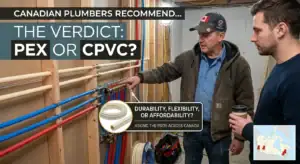
Today, most of the local plumbers in the GTA prefer to install PEX plumbing for most residential plumbing projects. Installation speed is a reality. A plumber toronto who is trusted by Toronto contractors can install PEX pipe in a home in just a fraction of the time it will take to solder copper or cement CPVC. That’s a money saving exercise for you when it comes to labour.
PEX is typically the go-to option when it comes to bathroom plumbing and kitchen plumbing upgrades. It can be used to route through walls without breaking the project, and PEX plumbing fittings provide tight and reliable connections that last for a century.
CPVC still recommends to be used for hot water lines directly off a water heater, outside uses where rigid pipe is required and sometimes on commercial works where high temperature performance is required.
It’s a truth universally acknowledged that the best plumbers near me are honest in Ontario. A combination of both is very effective. PEX for the distribution runs, CPVC or copper for the high heat zones near the water heater or outside plumbing houses that will be exposed to UV radiation.
Does Pex Plumbing Meet The Ontario Building Code?
Yes, completely. PEX plumbing has been used, approved by the Ontario Building Code, for years in new construction throughout the province. Same goes for CPVC. Fully certified and compliant with NSF/ANSI 61 standard for potable water.
When a contractor says no go, seek a second opinion!
Is PEX or CPVC Better For Canadian Winters?
PEX pipe wins with a clean sweep here. It is flexible and can expand when the water freezes in the pipe without the pipe splitting. CPVC is stiff and will crack when frozen for long.
PEX plumbing is the better option for long-term cold weather performance for homes located in the Niagara Region, Hamilton Mountain, older uninsulated homes in Etobicoke or Brampton where pipes are exposed in an unheated garage or crawlspace.
Common Problems With PEX Plumbing and CPVC Pipe
PEX plumbing and CPVC pipe are good materials to use when installed properly, but no plumbing system is maintenance free. Knowing what the most common problems are can enable homeowners to detect problems early and prevent them from causing expensive repairs.
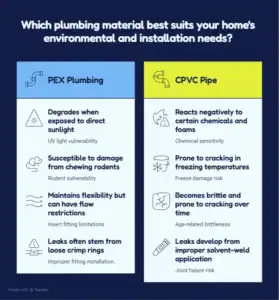
Common Problems With PEX Plumbing
Although PEX plumbing pipe is in use all across Canada, there are a few things that homeowners should know is a potential downside:
UV Exposure
PEX is sensitive to ultraviolet light. When not buried or protected from direct sunlight, PEX pipe can weaken and potentially fail over time. That is why it is never advisable to use PEX outdoors without protection.
Improper Fitting Installation
Leaks are not a pipe failure, but rather a result of poor installation. If the PEX fittings are improperly installed, crimp rings become loose or the PEX plumbing fittings are the wrong size, the fittings will eventually leak.
Rodent Damage
Rodents have been known to chew through PEX water pipe in unfinished basements and crawl spaces as well as in attics, although it’s rare. If the home has been treated for various types of pests in the past, it may need extra protection.
Reduced Flow Through Fittings
There are a few PEX pipe and fittings systems that employ fittings that slightly restrict the inside diameter of the pipe (insert-style fittings). This can impact water hydraulics in systems that are not well designed and have too many fittings.
Common Problems With CPVC Pipe
Like any piping material, CPVC pipe also has its own challenges.
Freeze Damage
This is one of the biggest worries of homeowners affected in Canada with cold temperatures. CPVC is not flexible, and can crack when water freezes in the pipe.
Brittleness With Age
Older CPVC systems may be brittle with time, particularly with temperature changes. This will make repairs more difficult and will also add to the chances for cracks.
Joint Failures
CPVC uses solvent-welded CPVC pipe fittings and CPVC fittings. Leaks can occur after several years if the adhesive is not properly applied during installation.
Chemical Sensitivity
Some spray foams, sealants, adhesives and building materials may adversely interact with CPVC, causing premature pipe failure.
Whether you decide to go with which material you prefer, the best way to get your home’s plumbing system to last as long as possible is to have it professionally installed and inspected regularly.
What Are The Downsides Of PEX Plumbing?
A few real ones worth knowing:
UV sensitivity: PEX pipe breaks down with prolonged sun exposure. Any run in a sunny basement window well or outdoor exposure needs to be protected or swapped for CPVC or copper.
Chemical leaching concerns: Some studies have noted that certain PEX products can affect taste in warm water conditions. All products sold in Canada must meet safety standards, but water taste is a real complaint in some homes with PEX water pipe systems.
Flow reduction at fittings: PEX fittings (especially insert-style) can reduce internal pipe diameter by up to 21–35% at each connection. In a system with many joints, that adds up. It’s one reason experienced plumbing repair professionals plan PEX runs carefully to minimize unnecessary fittings.
Rodent damage: Rare, but it happens. If you have an older home with a history of pests, talk to your plumber about this before committing to PEX plumbing pipe in exposed areas.
When Should You Call A Plumber Instead Of DIY This?
Both PEX and CPVC are offered as DIY materials, and they are, for the most part. However, there are times when using a 24 hour plumber or a licensed professional is your best defence against a much bigger issue in the future:
- You’re replacing old galvanized or copper pipes throughout the house
- You’re unsure about your local water chemistry affecting material choice
- A plumbing repair involves a wall, ceiling, or concealed space
- You need to connect to a gas line, water heater, or outside plumbing
- You have a sudden drop in water pressure, discoloured water, or wet spots on walls
Once that happens, any query you make for a 24 hour plumber near me with the words 24 will be the correct one. Burst pipes, faulty joints or leaks do not wait for Monday morning! Plumbing 24 hour emergency response is what you need when water is doing active damage to your home.
Which Pipe Is Better for New Construction and Renovations?
Choosing the right pipe for your needs is frequently dependent on the fact that you’re building a new home, upgrading a current home, or replacing old materials in your plumbing. Both PEX plumbing and CPVC pipe can be highly effective; however, each comes with its own set of pros and cons.
Best Pipe for New Construction
PEX plumbing is now the preferred choice for new construction throughout Ontario, by both builders and plumbers.
The flexibility of the pipe also permits installers to place long lengths of PEX plumbing pipe through walls, ceilings or floors with fewer connections. This will save time for installation, cut down on labor expenses, and eliminate potential leak locations in the plumbing system.
Benefits of PEX for new construction include:
- Faster installation
- Fewer fittings and joints
- Lower labour costs
- Better freeze resistance
- Easier routing through framing
- Reduced risk of future leaks
Many modern homes throughout Toronto, Mississauga, Oakville, Hamilton, Milton, Brampton, Cambridge, and Niagara are now built using PEX pipe and fittings because of these advantages.
Best Pipe for Home Renovations
PEX plumbing is typically the victor in matters of renovation projects.
PEX water pipe is flexible and can be installed with little disruption to walls and ceilings, which makes it a great choice for bathroom, kitchen, basement or aging water line replacement.
For instance, when plumbing is being replaced during a bathroom plumbing remodel, a plumber could be able to reach and fish PEX through existing wall holes, rather than needing to tear drywall. This benefit also extends to kitchen plumbing upgrades, which may have restricted access spaces.
This adaptability not only saves labour time but also results in cost savings for the homeowner in restoration expenses.
When CPVC May Be the Better Choice
Although PEX is the most common recommendation, CPVC pipe still has its place in certain projects.
CPVC may be a suitable option when:
- Extending an existing CPVC plumbing system
- Working near high-temperature water sources
- Matching existing pipe materials in older homes
- Certain commercial plumbing applications
- Areas where rigid piping is preferred
Using the same material as an existing system can sometimes simplify repairs and maintain consistency throughout the home’s plumbing network.
What Do Most Canadian Plumbers Recommend?
PEX plumbing is a popular choice among professional local plumbers for most residential projects, especially those that are new construction or renovation. It is flexible, freeze resistant and easy to install, making it ideal for the Canadian climate.
But each house has its unique characteristics. Water quality, budget, accessibility and pipe materials should always be taken into consideration before deciding.
When you’re not sure which is best for your home, you can always call a reliable plumber Toronto homeowners rely on, to make sure that your investment pays off for years.
About BOS Plumbing and Drains
BOS Plumbing and Drains has been serving Southern Ontario for over 20 years. Their team works across the whole GTA including Toronto, Mississauga, Oakville, Hamilton, Milton, Niagara, Cambridge, Brampton, and Etobicoke.
Whether you’re choosing between PEX plumbing and CPVC for a full repipe, dealing with a failing home plumbing system, or need someone on-site for an emergency, BOS brings the experience to get it right.
Their services include:
- Residential plumbing installation and repair
- Full pipe replacements using PEX or CPVC
- Emergency plumber and 24/7 response across the GTA
- Kitchen plumbing and bathroom plumbing upgrades
- Drain cleaning and drain repair
- Water heater installation
- Outside plumbing and hose bib installation
- New construction plumbing system installation
Need a reliable plumber Toronto homeowners can actually count on? BOS Plumbing and Drains is the team to call.