
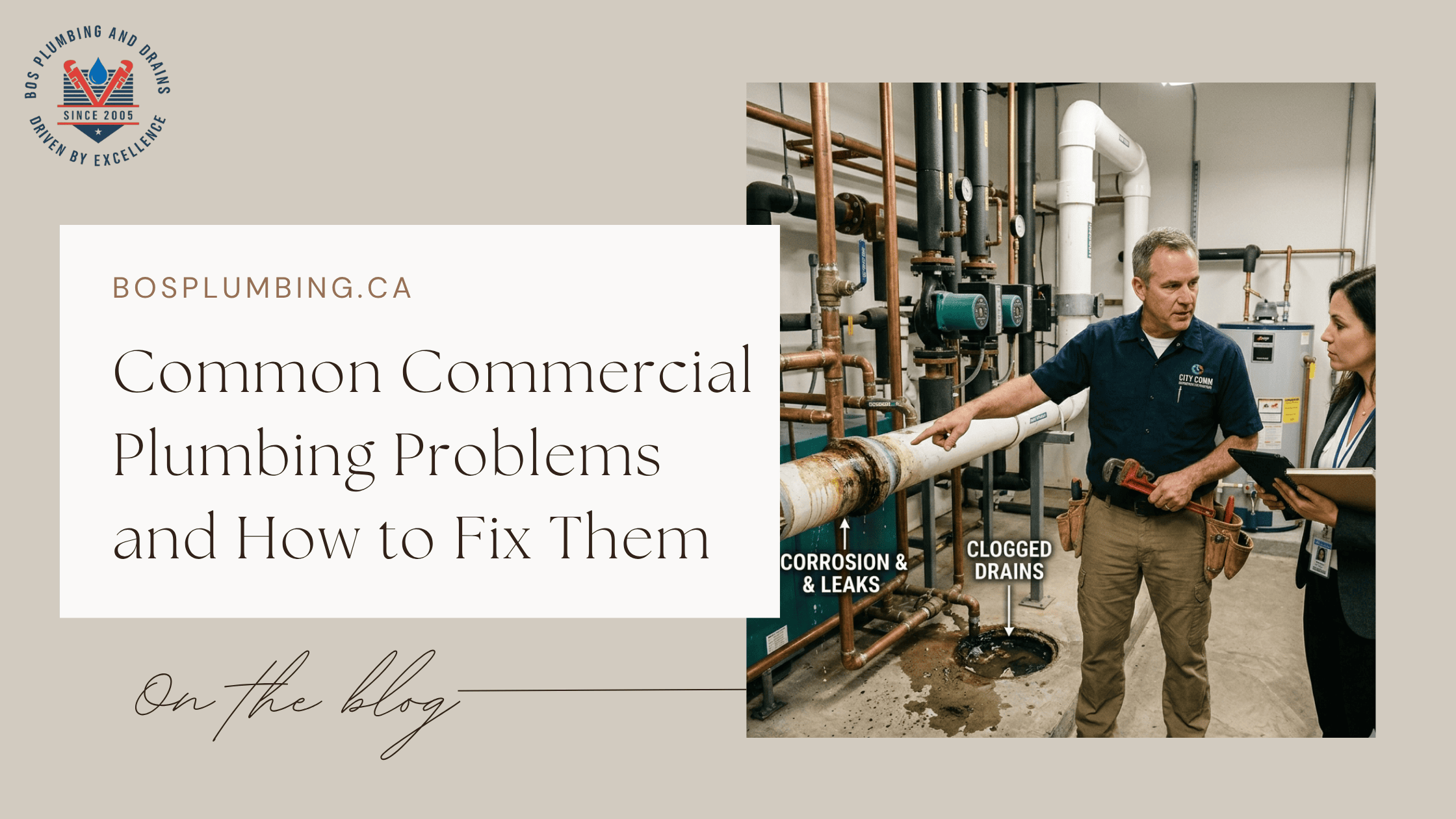
Operating a business in Canada presents a set of challenges all its own, whether it be trying to find your way through the “Big Freeze” in the Prairies or trying to maintain high-traffic facilities in the Greater Toronto Area. A big plumbing break is one of the things that can bring your operations to a crawl in a shorter period than a snowstorm.
As compared to a small leak at home, commercial plumbing problems are usually related to high-pressure systems, complicated layouts, and stringent health codes. Regardless of whether you run a restaurant in Mississauga, a retail centre in Oakville or an industrial warehouse in Hamilton, keeping ahead of the pipe maintenance is not just convenient, but also a bottom line protection.
BOS Plumbing and Drains have 20 years of experience as a partner of business owners in Milton to Niagara. We know that in the case of a commercial property, time is money, and a plumbing catastrophe does not take 9-to-5 hours.
Why Commercial Plumbing is a Different Beast
A clogged toilet is a nuisance in the afternoon in a residential establishment. In business, it could be a possible breach of health codes and PR nightmare. Business systems have much greater usage and structural requirements.
In the quest to hire
commercial plumbing companies in Canada, business owners are more than seeking a quick remedy; they require a long-term solution. In the case of industrial plumbing systems in the manufacturing facility up to the elaborate grease traps in a restaurant kitchen, the stakes are merely higher.
Property-Specific Challenges: What Could Go Wrong?
Every commercial property has its own “plumbing personality.” At BOS Plumbing and Drains, we’ve spent two decades identifying the specific vulnerabilities of different sectors:

1. Restaurants and Food Service
The main culprit in this case is FOG (Fats, Oils, and Grease). It is not only about food scraps in a kitchen sink clog of a busy restaurant, but about grease hardening in the drain pipes. Unless a commercial plumbing service has serviced your grease tap, there is a risk of a disastrous sewer line clog.
2. Retail Malls and Office Towers
Clogged toilets are a result of high traffic washrooms. Bathroom faucet dripping water on the 10th floor of a multi-story building can lead to water damage that may cause water to drip down to the 1st floor. Moreover, tall building constructions also experience problems with inadequate supply of water pressure on the higher levels, and they necessitate special booster pumps.
3. Industrial and Manufacturing Facilities
The industrial plumbing usually entails chemical grade piping and high pressure water mains. In a factory environment, even a single plumber leak repair could need expertise in backflow prevention and industrial
drain snaking to remove industrial waste.
4. Healthcare and Hospitals
Plumbing is an issue of life and death in healthcare. The accumulation of biofilms in a bathroom sink drain may contain harmful pathogens. These facilities need special commercial plumbing designs to avoid splashing and to deliver 100 per cent sterile water.
Top 10 Commercial Plumbing Problems You Can’t Ignore

1. The Infamous Clogged Toilet and Slow Drains
People tend to flush paper towels or hygiene products in public washrooms. Although a heavy-duty plunger may suffice in the short-term, in the case of deep-seated problems, professional drain snaking is needed to clear the pipe without ruining the infrastructure.
2. Silent Profit Killers: Leaky Fixtures
A bathroom faucet dripping may not seem a big problem, but when there are thousands of faucets in a large facility in Niagara or Burlington, the drips can lead to thousands of litres of wasted water. A majority of commercial faucets have cartridges that deteriorate due to heavy usage. A replacement of these early will save a sky-rocketing water bill.
3. Dealing with Canadian Winters: Frozen Pipes
The temperature changes can be so dramatic, that between Vaughan and Newmarket pipes can swell and contract to the point of bursting. Any pipes not well insulated are time bombs. When you see puddles or water spots in your ceiling, you need a plumber leak repair as soon as possible.
4. Sewer Gas Odours (The Dry P-Trap)
Floor drains are not common in commercial warehouses or in mechanical rooms. Sewer gases get into the building as the water in the P-trap evaporates. This can be remedied by merely charging the drain with water or putting in a trap primer.
5. Low Water Pressure and Failing PRVs
Low pressure may be an indication of a broken Pressure Reducing Valve (PRV) or a partial sewer line clog that is not visible and is impacting the whole system. The varying pressure places excessive pressures on your
drain pipes, and thus causes premature failure.
6. Water Heater Malfunctions
Commercial water heaters operate ten times more than a home one. Accumulation of sediments may result in knocking sounds and irregular temperatures. Shortage of hot water is a business killer in the hotel and tourism industry.
7. Backflow Prevention Failures
Commercial premises must have backflow preventers to ensure that dirty water does not flow into the clean water in the city. Should these devices not pass their annual test, there will be hefty fines and there would be the risk of water shut-offs.
8. Underground Pipe Collapse
The soil and tree roots may shift in older parts of Hamilton or Toronto and result in a total drain repair emergency. With camera inspections, BOS Plumbing and Drains is able to detect a collapse before sewage is in your lobby.
9. Improper Venting Issues
A venting system may be blocked, and this is likely to be indicated by gurgling sounds when a toilet flushes. Inadequate venting does not allow water flow, resulting in frequent clogs and gases trapped.
10. High Water Bills (The Running Toilet)
One running toilet may consume 750 litres of water per day. In a big business park, five or six running toilets would add a lot to your plumbing cost and no one would notice until the bill comes.
The Cost of Waiting: Why Proactive Maintenance Matters
Most managers are looking to get commercial plumbers near me when the water is already on the floor. But the plumbing cost of an emergency plumbing 24 hour visit is much more expensive than a routine visit.
Hydro-jetting and frequent check-ups can be invested in by investing in a relationship with established commercial plumbing companies such as
BOS Plumbing and Drains. Such a proactive strategy will make sure that your system is working with your business, and not against it.
Managing Emergency Repairs with BOS Plumbing
You have to call a plumbing 24 hour contact who will pick up in the middle of the night on a Tuesday when a pipe bursts. We provide our services to the Whole GTA, Mississauga,
Oakville, Hamilton, Milton and Niagara and our team is equipped with more than 20 years of practical experience in each location.
When you call on a drain repair or a plumber leak repair, you are not calling on some technician; you are calling on a licensed professional who is knowledgeable of the local codes as well as the pressure that your business is in.
DIY vs Professional Commercial Plumbing: What’s the Right Choice?
Most business owners would consider doing the repairs themselves when a plumbing problem arises so as to save money. Although small problems might be easy to handle, commercial plumbing is much more complicated in comparison to residential systems.
Even minor errors can cause larger damage, safety hazards, or code violations in commercial buildings such as restaurants, offices, hotels, and industrial buildings.
Here’s a clear comparison to help you decide:
| Factor | DIY Plumbing | Professional Commercial Plumbing Service |
| Cost | Lower upfront cost but may increase due to mistakes | Transparent pricing with long-term savings |
| Expertise | Limited knowledge of complex systems | Skilled and licensed technicians with 20+ years experience |
| Tools & Equipment | Basic tools only | Advanced tools (hydro jetting, camera inspections, drain snaking) |
| Time Efficiency | Time-consuming, trial-and-error approach | Fast diagnosis and same-day solutions |
| Compliance (Canada Codes) | Risk of violating local plumbing regulations | Fully code-compliant work across GTA |
| Problem Accuracy | May only fix surface issues | Identifies root causes (e.g., sewer line clog, hidden leaks) |
| Safety Risks | Higher risk of water damage or injury | Safe and professional handling |
| Long-Term Results | Temporary fixes | Durable, long-term solutions |
| Emergency Handling | Not suitable for urgent issues | 24/7 plumbing 24 hour emergency service |
Conclusion: Keeping Your Business Flowing
It can be a recalcitrant clogged toilet in a shopping center, or a complicated drain repair in a factory, but commercial plumbing must be done by a professional. Through knowledge about the traps prevalent in grease accumulation in Mississauga to frozen lines in Oakville you can undertake the action that will ensure that your facility runs smoothly.
Do not leave it in a kitchen sink clog to spoil your lunch break. Contact BOS Plumbing and Drains today to make an expert consultation. We have 20+ years of experience and keep your business high and dry.
Commercial Plumbing FAQ
1. How much does a commercial plumbing service cost in Canada?
The plumbing cost varies by province and the complexity of the job. Typically, commercial rates range from $100 to $250 per hour. Specialized equipment, like high-powered cameras for sewer line clog detection, may incur additional fees.
2. How often should I schedule commercial drain cleaning?
For high-traffic restaurants, a quarterly cleaning is recommended. For standard office buildings in the GTA, an annual inspection and cleaning of main drain pipes are usually sufficient to prevent major backups.
3. Why is my commercial water pressure so low?
Low pressure can be caused by a failing pressure-reducing valve (PRV), hidden leaks, or mineral buildup. A commercial plumbing service can perform hydraulic calculations to determine if you need a pressure-boosting system.
4. What is the difference between residential and industrial plumbing?
Industrial plumbing involves much larger scales and adherence to strict environmental regulations. It often handles higher volumes of waste and requires specialized certifications, like backflow prevention testing, to repair.
5. How often should commercial plumbing be serviced?
At least once every 6–12 months depending on usage and building type.
6. What is the best way to fix a kitchen sink clog?
Professional drain snaking or hydro jetting is the most effective method.
7. Why do commercial drains clog frequently?
High usage, grease buildup, and improper disposal are the main causes.
8. When should I call a commercial plumber?
Immediately when you notice leaks, backups, or increasing plumbing cost.